← Knowledge · Updated 6 November 2026 · 5 min read
This is general lab practice. The safety data sheet and CoA of the specific lot always take priority.
As a lyophilisate
Dry peptides are usually stored tightly sealed, cool and protected from light, for longer periods often at −20 °C or below.
Fridge or freezer?
| State | Short term | Longer term |
|---|---|---|
| Lyophilisate, unopened | Fridge, 2 to 8 °C | −20 °C or colder |
| Lyophilisate, opened | Dry and tightly sealed, in the fridge | With desiccant at −20 °C |
| In solution | Fridge, a few days | Aliquots at −20 °C or −80 °C |
Frost-free freezers cycle in temperature. For longer storage a freezer without a defrost cycle is better. The exact conditions for a lot are on its safety data sheet.
What breaks peptides down
Four factors decide how fast a peptide loses quality:
- Moisture: water enables hydrolysis and deamidation. Dry storage is therefore the most important measure.
- Temperature: chemical reactions run faster when warm. As a rule of thumb, each 10 °C rise speeds up many degradation reactions about two- to threefold.
- Oxygen: oxidises sensitive residues such as methionine and cysteine.
- Light: UV light can damage tryptophan and other aromatic residues.
The storage advice below aims to keep all four factors low.
Before opening
Let the vial reach room temperature in a desiccator. Opened cold, moisture condenses on the hygroscopic material and speeds up degradation.
In solution
Peptides are much less stable in solution. Single-use aliquots work well, because they avoid repeated freeze-thaw cycles.
A slightly acidic buffer around pH 5 to 6 slows degradation for many peptides. For small amounts, low-binding tubes help, because peptides otherwise stick to the wall.
Making aliquots properly
- Dissolve the peptide once, completely, in a known volume.
- Split the solution straight away into portions of one experiment each.
- Use low-binding tubes with tight-fitting lids.
- Label each tube with product, lot, concentration and date.
- Freeze the aliquots promptly and thaw them one at a time as needed. A thawed aliquot is not refrozen.
How to recognise degradation
Visible signs are rare but telling. A lyophilisate that clumps, looks glassy or has shrunk has often taken up water. A solution that turns cloudy or shows particles contains aggregates. Most degradation products are invisible, though. They can only be detected reliably by analysis, such as LC-MS: oxidation shows as +16 Da, deamidation as +1 Da.
Receiving and shipping
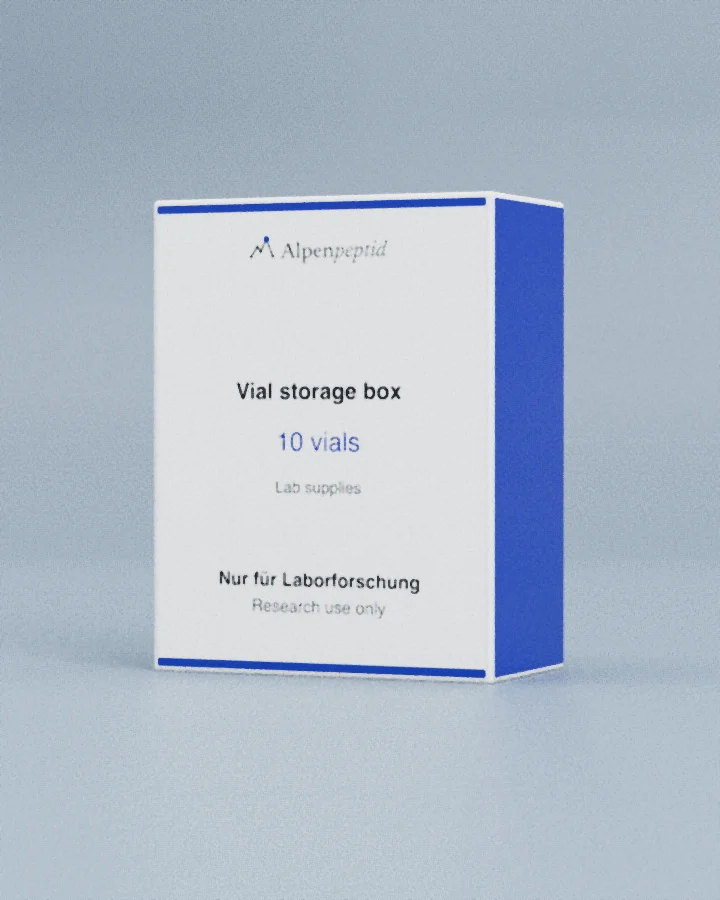
Lyophilisates usually tolerate shipping at room temperature for a short time. Still, store the vials as intended as soon as they arrive. Record the lot, date received and storage location so each vial can be traced later. A storage box keeps vials in order and out of the light.
Points for particular peptide groups
| Peptide group | What to watch |
|---|---|
| Short peptides without sensitive residues | Usually robust as a lyophilisate; store dry and cool |
| Peptides with methionine, cysteine or tryptophan | Limit air exposure, don’t open vials needlessly |
| Long peptides and lipidated peptides | More prone to aggregation in solution; keep aliquots small |
| Peptides with asparagine or glutamine | Avoid basic pH in solution |
| Peptide mixes in one vial | Store according to the least stable component |
Checking stability in solution yourself
How long a solution stays usable depends on sequence, pH, temperature and concentration. Very dilute solutions often lose content faster, because a larger share of the peptide sticks to the container wall. For important series of experiments, a small stability check of your own pays off: measure the solution by HPLC on the day it is made, and repeat after one and two weeks under the same storage conditions. If the main peak shrinks or side peaks grow, the solution is not stable enough for that period.
Order in the fridge and freezer
- Sort vials by expiry date and use the oldest lot first.
- Use labels that withstand cold and condensation.
- Keep a simple inventory with product, lot, amount and storage location.
- Check the temperature regularly, ideally with a data logger that also records failures.
- Store peptides away from food and strong-smelling chemicals.
Storing solvents and supplies
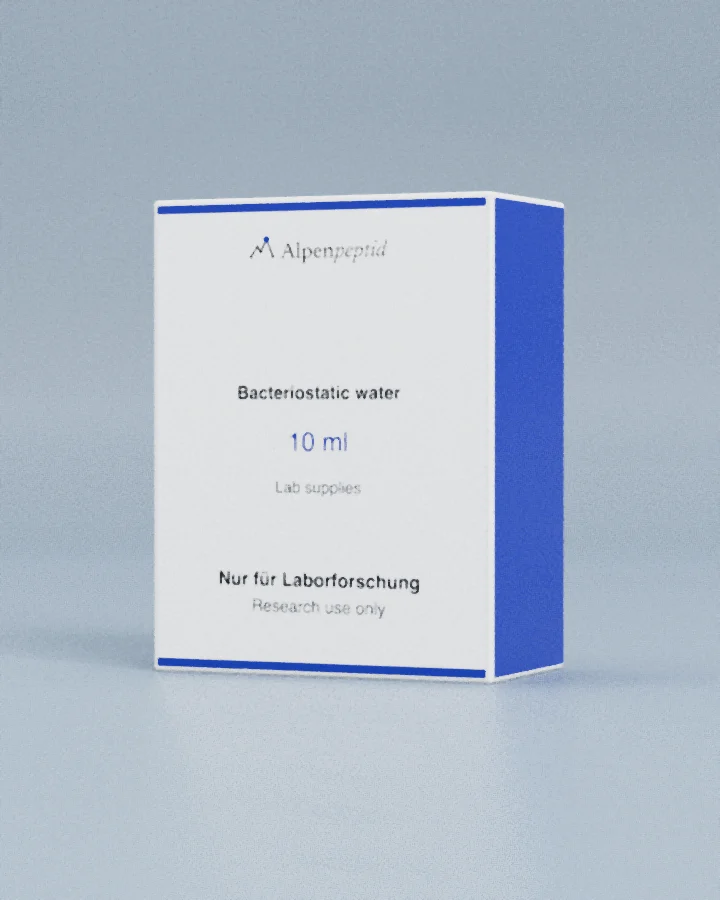
Bacteriostatic and sterile water are stored as the manufacturer states, opened containers marked with the date of first withdrawal. Syringes and alcohol swabs stay in their sealed packaging until use, dry and protected from dust. That keeps each individual pack sterile.
Sensitive residues
The sequence determines sensitivity:
- Cysteine, methionine, tryptophan: prone to oxidation, so limit air exposure.
- Asparagine, glutamine: prone to deamidation, especially at basic pH.
- Aspartate: prone to isomerisation and cleavage at certain sequences.
Which solvent suits your preparation is covered in Peptide solubility and Bacteriostatic water in the lab.
Common questions
How long does a lyophilisate keep in the fridge? For a few weeks this is uncritical for many peptides. For months or years, −20 °C or colder is usual. The lot’s expiry date and safety data sheet are the reference.
Can I freeze and thaw a vial several times? As a dry lyophilisate this matters less, as long as no condensation gets in. A solution, by contrast, should be thawed only once. That is why aliquots are the better choice.
Do I need to store peptides under inert gas? For most peptides a tightly sealed vial is enough. For sequences very prone to oxidation, with methionine or cysteine, overlaying with nitrogen or argon can make sense.
What if a parcel sat somewhere warm for a few days? Lyophilisates usually tolerate a short time at room temperature well. Store the vials as intended straight away afterwards. If there are visible changes, the lot should not be used for critical experiments.
Is a lab fridge better than a household fridge? Lab fridges hold the temperature more evenly and often have an alarm. A household fridge can be clearly warmer or colder in the door and near the evaporator. Store vials in the middle there if possible, not in the door.
For laboratory research use only. Not for use in humans or animals.